

Avoid Closed Questions in UX Research: Boost Discovery Sessions

Brandhero Team
Discover how closed questions hinder UX research and learn to rewrite them into open-ended ones that uncover deeper insights and improve user understanding.
The questions you ask in research matter. And there's one type that consistently kills discovery sessions: closed questions.
You know the feeling. You're in a user interview, and it's stiff. One-word answers. Awkward pauses. You're not getting anything useful. Closed questions are usually the culprit.
We all know the "why" matters more than a simple yes or no. Yet these questions keep showing up in our scripts anyway, throttling what we can learn.
So let's talk about what closed questions are, why they're a problem in UX research, when they're actually fine, and how to rewrite them into open-ended ones that work.
What closed questions are
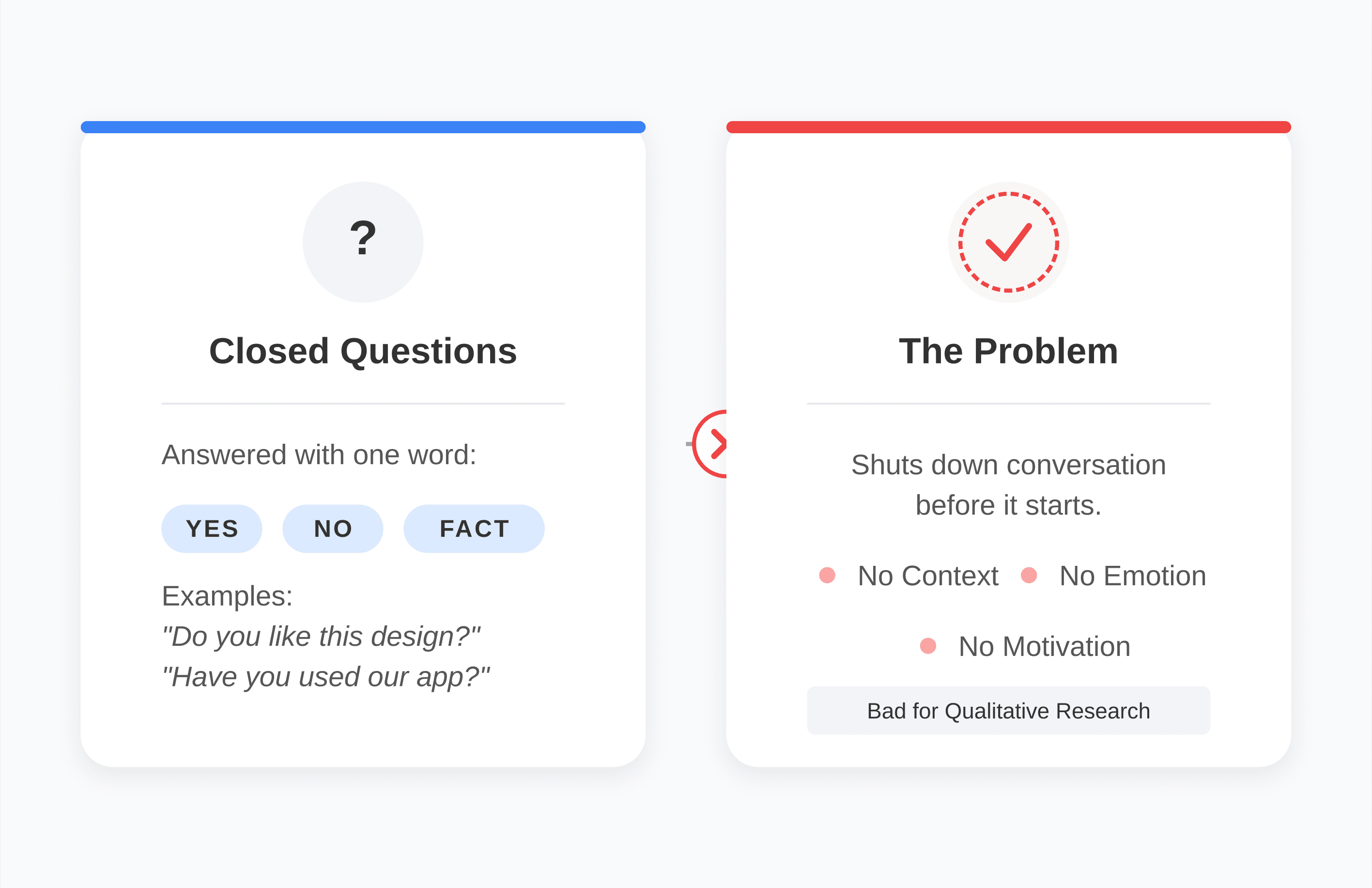
They're questions you can answer with one word usually "yes," "no," or a quick fact.
Do you like this design?
Have you used our app before?
Would you recommend this product?
They seem fine. Direct, easy, fast. But that's the problem they shut down the conversation before it starts. When you're doing qualitative research, you want context, motivation, emotion. Closed questions don't give you that.
Why they kill research quality
They box users in. Ask "Do you find this interface intuitive?" and you're asking for a yes/no judgment. But experience isn't binary. They might find some parts intuitive and struggle with others. Forcing a binary answer loses the nuances that could change your design decisions.
They leak bias. "Is this button easy to find?" suggests it should be easy. Users want to be helpful, so they might agree even if they struggled. That creates false positives in your data.
They give you surface-level data. A "yes" or "no" tells you nothing about mental model, past experience, expectations, or context. It might confirm what you believe, but it won't uncover what you don't know.
They make users feel tested. Closed questions can feel like a quiz. Instead of a natural conversation, users feel examined. That makes them guarded.
When closed questions are actually fine
They're not all bad. Just not in exploratory research.
Screening: "Have you bought something online in the last month?" qualifies participants fast.
Demographics: "What's your age range?" gets factual data quickly.
Quant surveys: When you need stats from a large group, closed questions make analysis possible.
Fact-checking: "Did you get a confirmation email after checkout?" verifies a yes/no scenario.
Clarifying after open questions: Once someone shares detailed thoughts, a closed question can help: "So you preferred the first option is that right?"
The point is context. In discovery, concept validation, usability testing where "why" is critical closed questions should be rare.
The real cost: a practical example
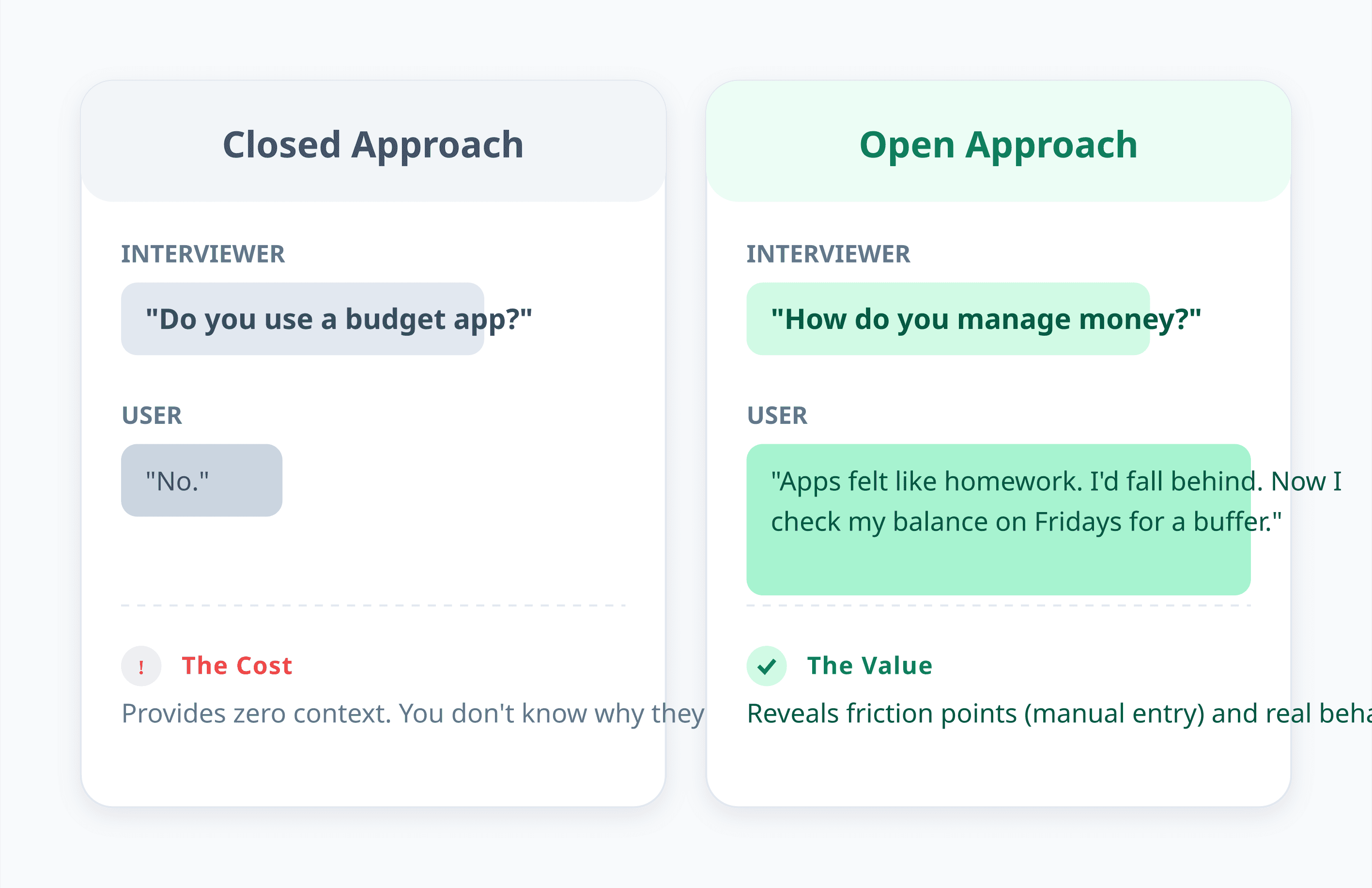
Say you're designing a financial wellness app for young professionals, and you're interviewing them about budgeting.
Closed approach:
"Do you use a budgeting app?"
"No."
"Okay. Do you find it hard to track expenses?"
"Sometimes."
This tells you almost nothing.
Open approach:
"Tell me about how you manage your money and keep track of spending."
"Well, I used to try budgeting apps, but honestly they felt like homework. I'd have to manually enter every transaction, and I'd fall behind within a week. Now I just check my bank balance on Fridays before the weekend and try to keep some buffer. It's not perfect I definitely overspend sometimes on takeout but at least it doesn't feel like another chore."
Now you have context. You've learned about previous experience with budgeting tools, pain points (manual entry, maintenance burden), current workarounds, specific spending weaknesses, and emotional factors (feeling like homework, wanting simplicity).
This is insight you can actually use. You might explore automatic transaction syncing, weekly check-ins instead of daily, or focusing on overspending categories.
How to rewrite closed questions
Most are easy to fix.
"Do you…" → "How do you…" or "Tell me about…"
"Do you shop online frequently?" → "Tell me about your online shopping habits."
"Do you find checkout easy?" → "Walk me through how you experienced checkout."
"Did you…" → "What happened when…"
"Did you have issues setting up your account?" → "What was your experience setting up your account?"
"Did you notice the help icon?" → "What did you notice first on this page?"
"Is this…" → "What are your thoughts on…"
"Is this design appealing?" → "What are your first impressions?"
"Is the navigation clear?" → "How would you describe the navigation experience?"
"Would you…" → "What would make you…"
"Would you recommend this product?" → "What would need to happen for you to recommend this to a colleague?"
"Would you use this feature?" → "How might this fit into your current workflow?"
Techniques for better questions
Start broad. Begin with wide-open prompts that let participants define what matters:
"Tell me about your day-to-day experience with [task/problem]."
"What challenges do you face when [doing something]?"
"Walk me through the last time you [performed this action]."
Don't assume. Let them tell their story.
Use "Five Whys." When you get a brief answer, dig deeper by asking "why" or variations. This approach, covered more in our piece on ethnography in UX, uncovers root causes.
Example:
"I don't like this layout."
"What about it doesn't work?"
"It feels cluttered."
"What makes it feel cluttered?"
"There's too much competing for my attention."
"When you're using a tool like this, what matters most?"
"I really just need recent transactions and my balance. Everything else is noise."
Now you understand what they don't like, why, and what they actually need.
Use silence. Just be quiet after asking. Pauses give participants time to think, often leading to deeper responses.
If someone gives a brief answer:
"Tell me more about that…"
Nod and maintain eye contact to signal interest
Reflect back: "So it sounds like [summary]…" which often prompts expansion
Ask about specific experiences, not opinions. Behavior-based questions beat hypothetical ones.
"Do you think you would use this feature?" → "Tell me about the last time you needed to [perform this task]. How did you handle it?"
Real stories reveal pain points and context that hypothetical scenarios can't.
Common traps
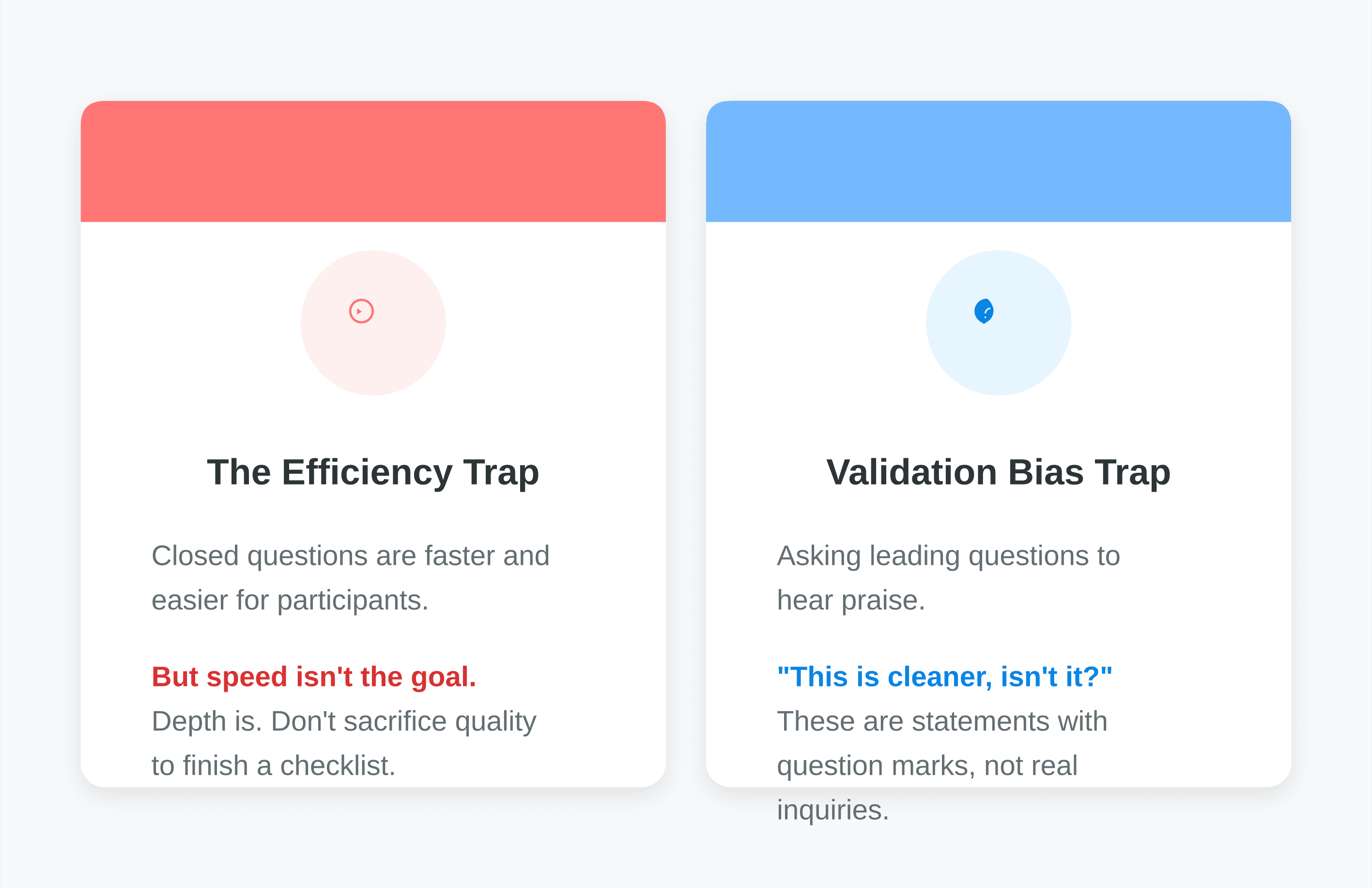
The efficiency trap. Closed questions are faster. You get through your list quicker, and participants don't have to think as hard. But speed isn't the goal of qualitative research depth is. If you're always running out of time, you need longer sessions or a tighter scope, not faster questions.
The validation bias trap. When you've worked hard on a design, you want to hear it's good. That leads to questions seeking confirmation instead of truth:
"This dashboard is cleaner, isn't it?"
"You can tell what this icon means, right?"
These aren't questions they're statements with question marks. Have someone else review your script, and actively try to disprove your assumptions.
The fear trap. Sometimes closed questions come from fear of what you might hear. An open question might reveal users hate something you spent months building. A closed question with a favorable answer lets you move on.
But that's the whole point of research learning the truth before investing more in the wrong direction.
Building better habits
Get comfortable not knowing. The best researchers are genuinely curious, even when they're domain experts. They don't assume they know what users will say. This mindset naturally leads to open questions.
Listen more than you talk. The participant should be doing 80% of the talking. If you're explaining, justifying, or sharing your own experiences, you've lost the thread.
Practice. Like any skill, this improves with repetition. After each session:
Note which questions got rich responses
Spot where closed questions shut down threads
Brainstorm how to reframe them
Refine your script for next time
Record sessions (with permission) and review them. You'll catch patterns you missed in the moment.
Creating a research culture that values open discovery
If you're part of a UX design agency or internal team, question quality affects everyone.
Collaborative script review. Before major research, have team members review discussion guides specifically for closed questions that could be opened.
Share insights in context. When presenting findings, show actual quotes and stories, not just the what. This demonstrates the value of open-ended exploration.
Resist pressure to "just ask." Stakeholders sometimes want quick answers: "Do users want this feature?" Push back by explaining that the real question is what problem they're solving and whether this feature solves it.
Train non-researchers. If product managers or developers sometimes conduct research, offer training on question techniques. The closed-question habit runs deep, especially for beginners.
The business impact
This isn't theoretical. Question quality has direct business implications. Companies that invest in user experience research methods that go deep rather than just wide see measurable returns.
Better questions lead to more accurate user understanding, stronger product-market fit, higher satisfaction and retention, and more efficient development because you're not rebuilding after missing the mark.
When you understand the "why" behind user behavior, you make smarter decisions. You don't just know that users abandoned checkout you understand they left because they couldn't find guest checkout and didn't want another account. That insight leads to a specific, actionable fix.
The shift
Moving from closed to open questions is a mindset shift, not just a technical one. It means letting go of the illusion of control and embracing the messiness of real human experience.
Closed questions feel safe because they're bounded. Open questions feel risky because you don't know where they'll lead. But that uncertainty is where insight lives.
Next time you prepare for research, challenge every closed question. Ask yourself what you're actually trying to learn. Then craft a question that gives users space to teach you something unexpected.
If you're looking to strengthen your research practice, understanding how to create user personas based on rich qualitative insights is a natural next step. Your personas reflect the quality of the questions you asked.
Start with curiosity. Ask openly. Listen deeply.
Explore all blogs

Jun 18, 2026
Enhancing Customer Service Through UX Design & Strategic Audits
Enhancing Customer Service Through UX Design & Strategic Audits

Jun 16, 2026
User Insights: Unlocking Design Decisions with Data
User Insights: Unlocking Design Decisions with Data

May 31, 2026
User Experience Optimization: Boost Conversion & Retention
User Experience Optimization: Boost Conversion & Retention

May 31, 2026
User Experience Optimization: Fixing Friction for Growth
User Experience Optimization: Fixing Friction for Growth

May 11, 2026
Phone Number Chunking: Reduce Errors & Improve Conversion Rates
Phone Number Chunking: Reduce Errors & Improve Conversion Rates

May 9, 2026
Mastering Gating in UI/UX Design: Convert Without Pushing
Mastering Gating in UI/UX Design: Convert Without Pushing

May 7, 2026
Gestalt Laws Explain Visual Grouping for Designers
Gestalt Laws Explain Visual Grouping for Designers

May 6, 2026
Checklist for Evaluating Microinteractions in UX
Checklist for Evaluating Microinteractions in UX