

Designing Natural Conversational AI Experiences | Brandhero Design

Brandhero Team
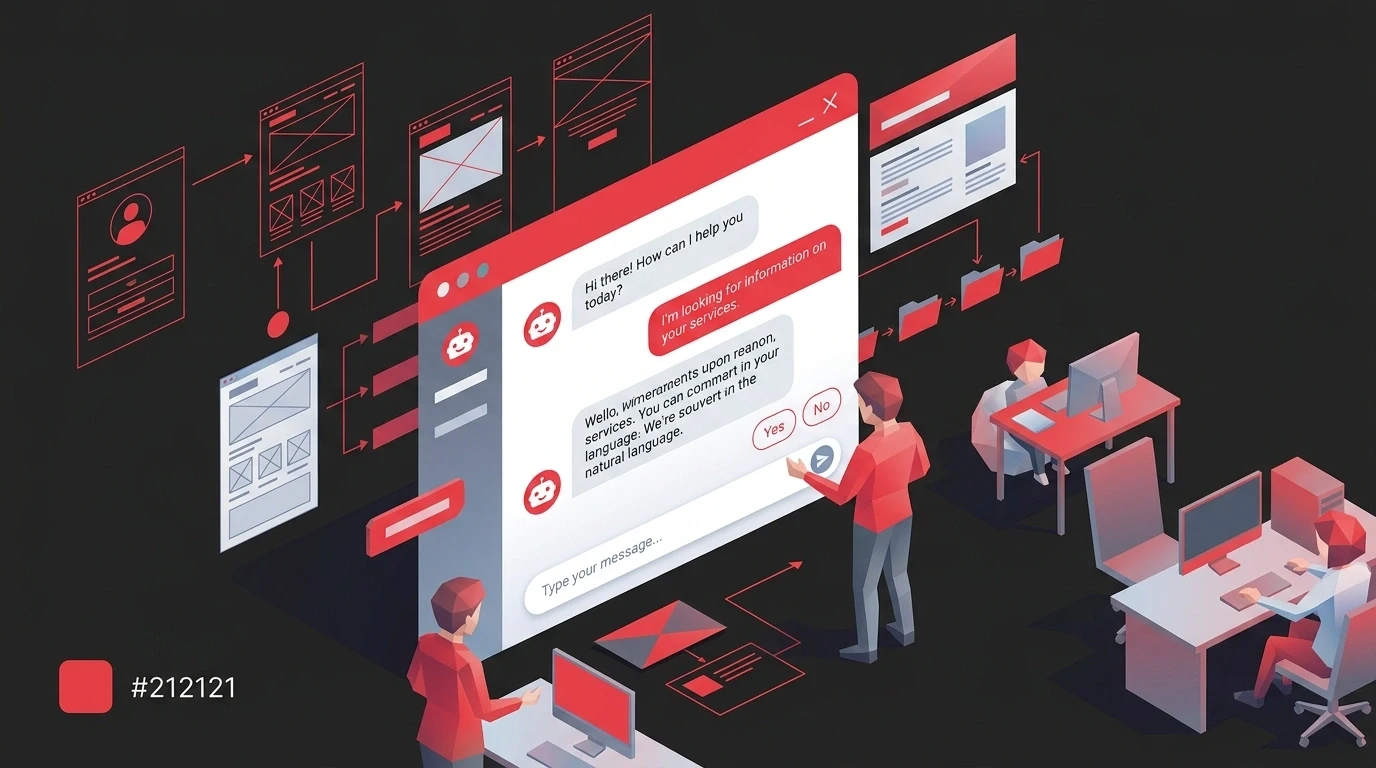
Explore how to design conversational AI that feels natural and helpful. Learn core principles, common mistakes, and strategies for success with Brandhero Design.
Conversational AI is everywhere now. Chatbots answer queries at 2 AM. Voice assistants book appointments. AI agents guide users through complex workflows. But most of these experiences feel robotic, frustrating, and forgettable.
The technology has matured. The design hasn't caught up.
Users don't just want functional AI they want experiences that feel natural and helpful. That's where conversational AI design comes in. At Brandhero Design, we've worked with startups and established companies trying to solve this exact problem: how do you design conversational interfaces that people actually want to use?
What Makes Conversational AI Design Different
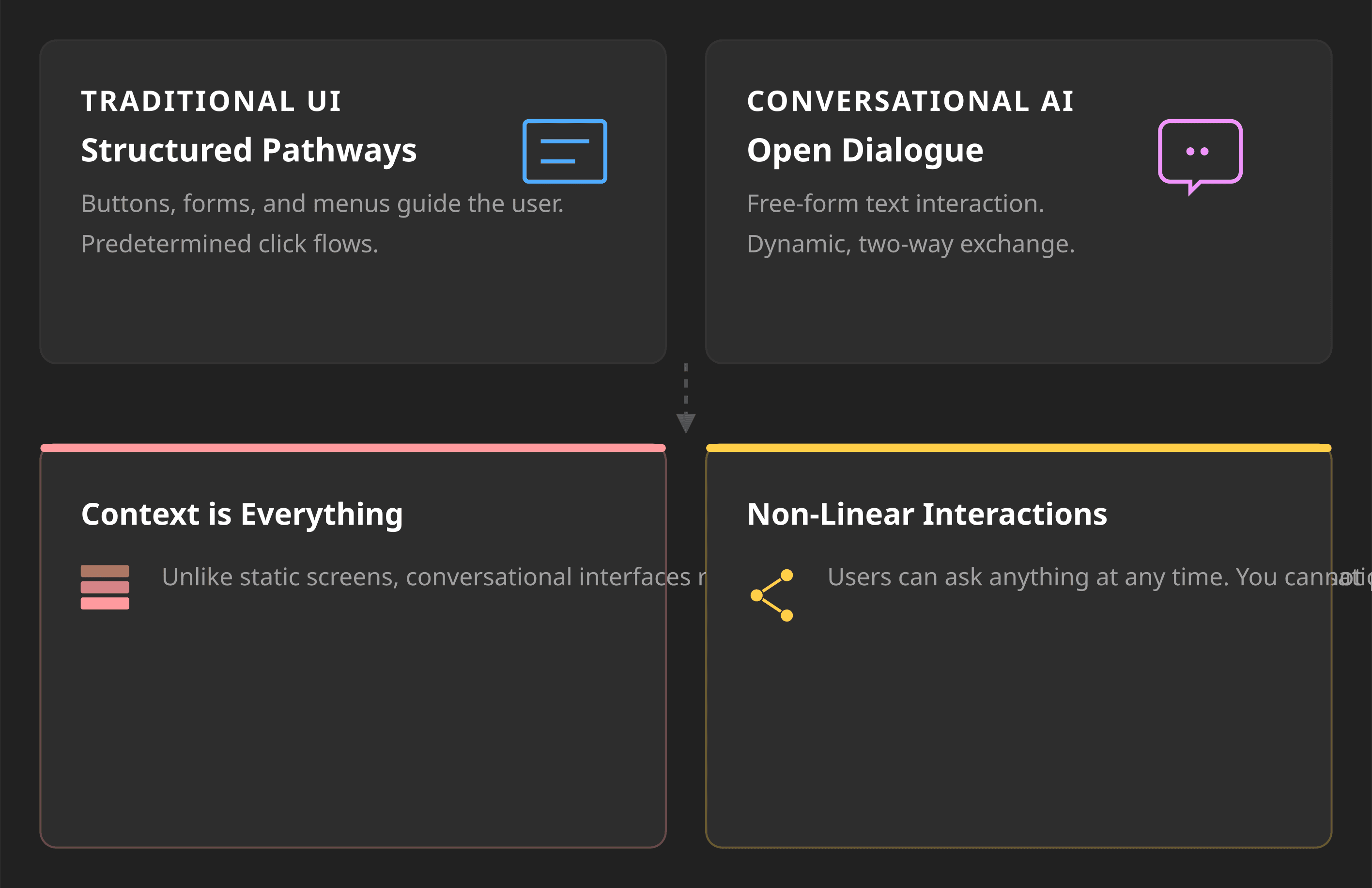
Traditional UI design gives users buttons, forms, and navigation menus structured pathways through an interface. Conversational AI flips this. Instead of clicking through predetermined paths, users engage in open-ended dialogues.
This creates some specific headaches:
Context is everything. Unlike static screens where all information is visible, conversational interfaces rely on memory. The AI needs to remember what users said three exchanges ago and respond appropriately.
Non-linear interactions. Users can ask anything at any time. You can't predict every possible utterance or conversational branch. Traditional wireframes and user flows fall short here.
Tone and personality matter immensely. In graphical interfaces, personality comes through visual design colors, typography, imagery. In conversational AI, personality emerges through language, response timing, and how the AI handles mistakes.
Error recovery is make-or-break. When users click the wrong button, they can usually navigate back. When conversational AI misunderstands, users often abandon the interaction entirely.
The Business Case
Why should businesses care about conversational AI design specifically?
The numbers are stark. According to research from Juniper Networks, chatbots and conversational AI are expected to save businesses $11 billion annually by 2026 that's this year. But poorly designed conversational experiences drive users away. A Tidio study found that 62% of consumers would rather wait for a human agent than interact with a badly designed bot.
The opportunity cost is massive. When done right, conversational interfaces can reduce support costs by deflecting routine inquiries, increase conversion rates through instant guidance at decision points, improve accessibility for users who struggle with traditional interfaces, and scale personalization in ways static web pages cannot.
One fintech startup we worked with saw a 43% reduction in support tickets and a 28% increase in onboarding completion rates after redesigning their chatbot experience. The technology hadn't changed only the conversational design.
For startups, getting this right early can become a real competitive advantage. As our UI/UX design work demonstrates, user experience often determines which products win in crowded markets.
Core Principles
Whether you're designing a customer service chatbot, a voice assistant, or an AI agent embedded in your product, these principles will help.
Design for Conversation, Not Just Responses
The biggest mistake we see is treating conversational AI like a fancy FAQ system users ask questions, the bot spits out answers. Real conversations don't work that way.
Effective conversational design includes turn-taking dynamics. Human conversations follow rhythms we pause, we acknowledge, we build on previous statements. Your AI should too. Brief acknowledgments ("Got it, let me find that for you") before longer responses make interactions feel more natural.
Don't overwhelm users with information. Reveal details progressively, asking clarifying questions when needed.
When misunderstandings happen (and they will), the AI should acknowledge the confusion, offer alternative interpretations, and recover gracefully. Phrases like "I'm not sure I understood that correctly. Did you mean X or Y?" work far better than generic error messages.
Establish Clear Personality and Voice Guidelines
Your conversational AI represents your brand through direct dialogue. This requires crystal-clear voice and tone guidelines.
Start by answering these questions:
Is your AI formal or casual?
Does it use humor? If so, what kind?
How does it handle sensitive topics?
What's off-limits conversationally?
How does personality shift across different contexts?
Document specific language patterns, vocabulary, and response structures. Create a comprehensive style guide just as you would for your brand's visual identity.
One tactical tip: develop "personality cards" for your AI brief profiles covering traits, values, and behavioral guidelines. This gives designers, writers, and developers shared reference points.
Design Conversation Flows, Not Just Screens
Traditional UX design tools wireframes, mockups, prototypes don't translate well to conversational AI. You need different artifacts:
Dialogue trees map possible conversational paths, but acknowledge they can't cover every possibility. Focus on the happy paths and most common edge cases first.
Sample conversations provide concrete examples of how interactions should unfold. Write dozens of these covering various user intents, moods, and contexts.
Intent taxonomies catalog what users might want to accomplish and the different ways they might express those intentions. "I need to change my password," "I forgot my login," and "Can't access my account" might all map to the same underlying intent.
Entity lists define the data points your AI needs to extract from user input names, dates, account numbers, product types.
These artifacts replace or supplement traditional deliverables. Spending time on these foundational elements dramatically reduces costly iteration later.
Prioritize Transparency and Control
Users need to understand what your conversational AI can and cannot do. Mysterious black boxes breed frustration and mistrust.
Build transparency through clear capability statements. Tell users upfront what the AI can help with. "I can help you track orders, update account details, or answer product questions" sets appropriate expectations immediately.
When the AI can't handle a request, make the transfer to human support seamless and explained. "This requires specialist help. I'm connecting you with Sarah from our billing team" is vastly better than a dead-end.
Let users pause, restart, or exit conversations easily. In voice interfaces, phrases like "cancel," "start over," or "talk to a person" should always work.
The principle here extends beyond just conversational AI it's fundamental user experience design adapted for conversational contexts.
Test with Real Language, Real Users
Conversational AI exposes the gap between how we think users will interact and how they actually do. The only solution is extensive user testing with real conversational data.
Wizard of Oz testing in early stages lets designers simulate AI responses manually while users interact naturally. This reveals language patterns, user expectations, and common misunderstandings before you've built anything.
Conversation logging and analysis once launched provides invaluable data. Look for patterns in where users get stuck, what they ask repeatedly, and how they rephrase when the AI misunderstands.
A/B testing different conversational strategies helps optimize over time. Test response length, personality variations, proactive suggestions, and recovery strategies systematically.
Unlike traditional UI where you can observe clicks and navigation, conversational AI requires analyzing language a messier, more qualitative challenge. Budget time and resources accordingly.
Common Mistakes (and How to Avoid Them)
Even experienced UX designers stumble when transitioning to conversational AI. Here are pitfalls we've seen repeatedly:
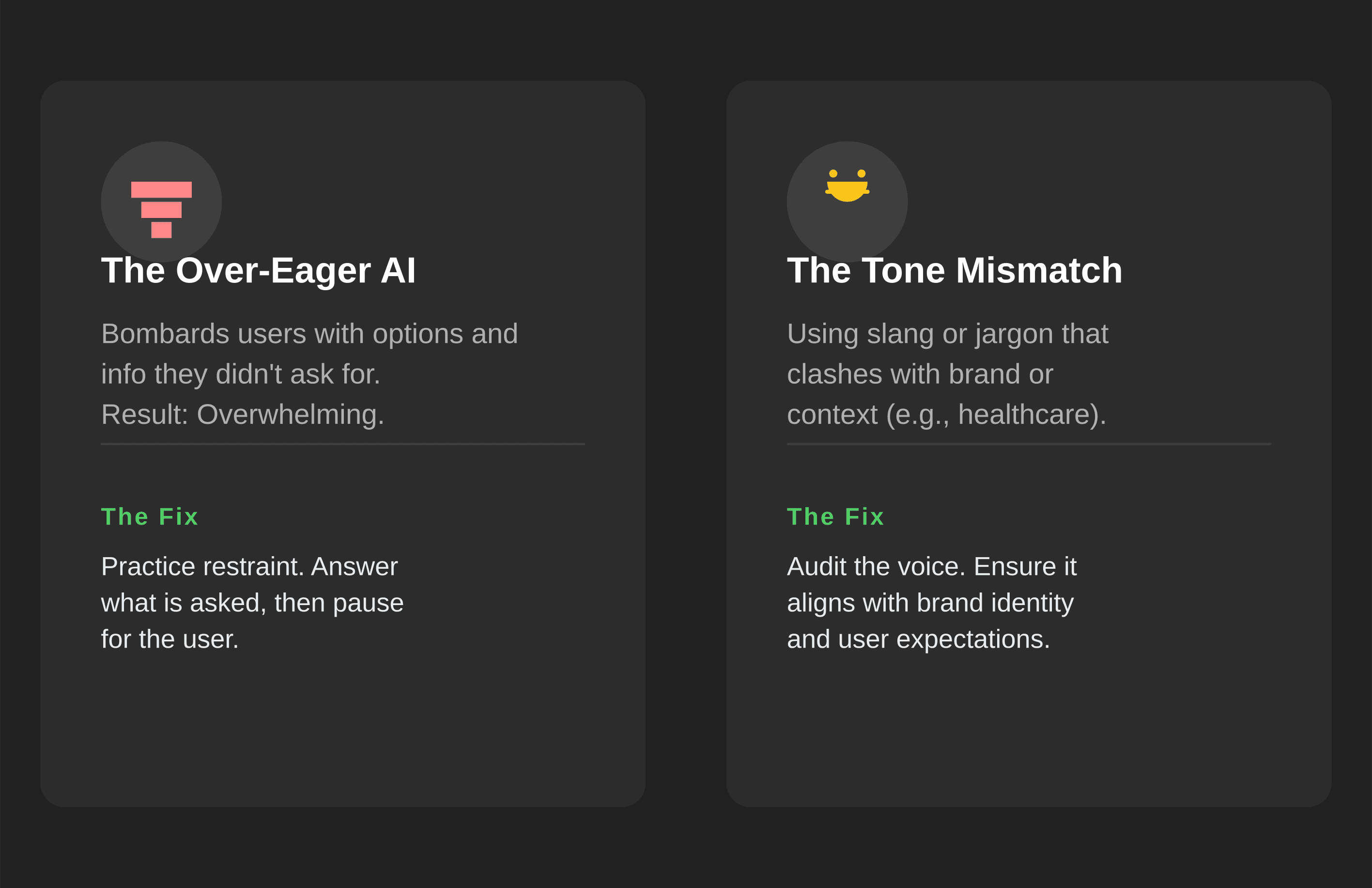
The Over-Eager AI
This bot can't stop talking. It bombards users with options, suggestions, and information they didn't ask for. The intent is helpful, but the experience feels overwhelming.
The fix: Practice restraint. Answer what's asked, then pause for user response. Offer additional help, but don't force it.
The Tone Mismatch
Your AI's tone clashes with your brand or user context. A healthcare chatbot using slang creates discomfort. A gaming AI speaking in corporate jargon feels lifeless.
The fix: Ground personality decisions in user research and brand guidelines. Test tone variations with target users. When in doubt, aim for professional-friendly warm but competent.
The Dead-End Conversation
Users hit scenarios where the AI says "I can't help with that" without offering alternatives or next steps. Conversation stops cold.
The fix: Every limitation needs a pathway forward. Can't answer the specific question? Offer related help or connect to a human. Even "I'm not sure, but I can connect you with someone who knows" maintains momentum.
The Amnesia Problem
The AI forgets context users provided moments earlier, forcing repetition and killing conversational flow.
The fix: Implement robust context management. The AI should remember user details throughout the session and, ideally, across sessions. When context expires, acknowledge it: "It's been a while since we last chatted. Could you remind me which account you're working with?"
The One-Size-Fits-All Response
The AI responds identically to "help" from a confused first-time user and an experienced power user with a specific technical question.
The fix: Implement user profiling and adaptive responses. Tailor verbosity, technical depth, and suggestions to user sophistication and history.
Using AI to Design AI
Should we use AI to design AI experiences?
Increasingly, yes with caveats.
Large language models can help generate dialogue variations, identify edge cases, and even draft initial conversation flows. They're particularly useful for creating diverse sample conversations for testing, suggesting alternative phrasings for specific intents, identifying potential misunderstandings in dialogue flows, and generating responses that match established voice guidelines.
But AI cannot replace human judgment in conversational AI design. The strategic decisions around personality, ethical considerations, business alignment, and user empathy still require human designers.
We've found the most effective approach combines AI assistance with human creativity and oversight, much like the broader principle we explore in our piece on AI in design: where it helps and where humans lead.
Think of AI as a sophisticated design tool powerful and efficiency-enhancing, but not a replacement for design thinking and user-centered strategy.
Measuring Success
You've designed and launched your conversational AI. How do you know if it's working?
Traditional UX metrics still matter task completion rates, time to resolution, user satisfaction scores. But conversational AI demands additional measurement approaches:
Conversation completion rate: What percentage of users reach their goal without abandoning or escalating to human support?
Turn depth: How many conversational turns does it take to resolve typical requests? Lower is generally better, but not at the expense of helpfulness.
Misunderstanding frequency: How often does the AI fail to grasp user intent? Track this by analyzing conversations where users rephrase, express frustration, or explicitly correct the AI.
Handoff rate: What percentage of conversations transfer to human agents? Some handoff is expected and healthy zero handoff often means users are abandoning rather than asking for help.
User sentiment analysis: Analyze the language users employ. Frustrated users use different words and patterns than satisfied ones.
Return user engagement: Do people come back to use the conversational AI again, or do they avoid it after one bad experience?
Create dashboards that surface these metrics alongside sample conversations. Numbers tell you that something's wrong; conversation samples reveal what and why.
Continuous improvement is essential. Unlike static interfaces that change through discrete releases, conversational AI benefits from ongoing optimization. Small tweaks to language, flow, and personality can yield significant improvements.
A Practical Roadmap
Ready to dive into conversational AI design? Here's a pragmatic roadmap based on our experience at Brandhero Design:
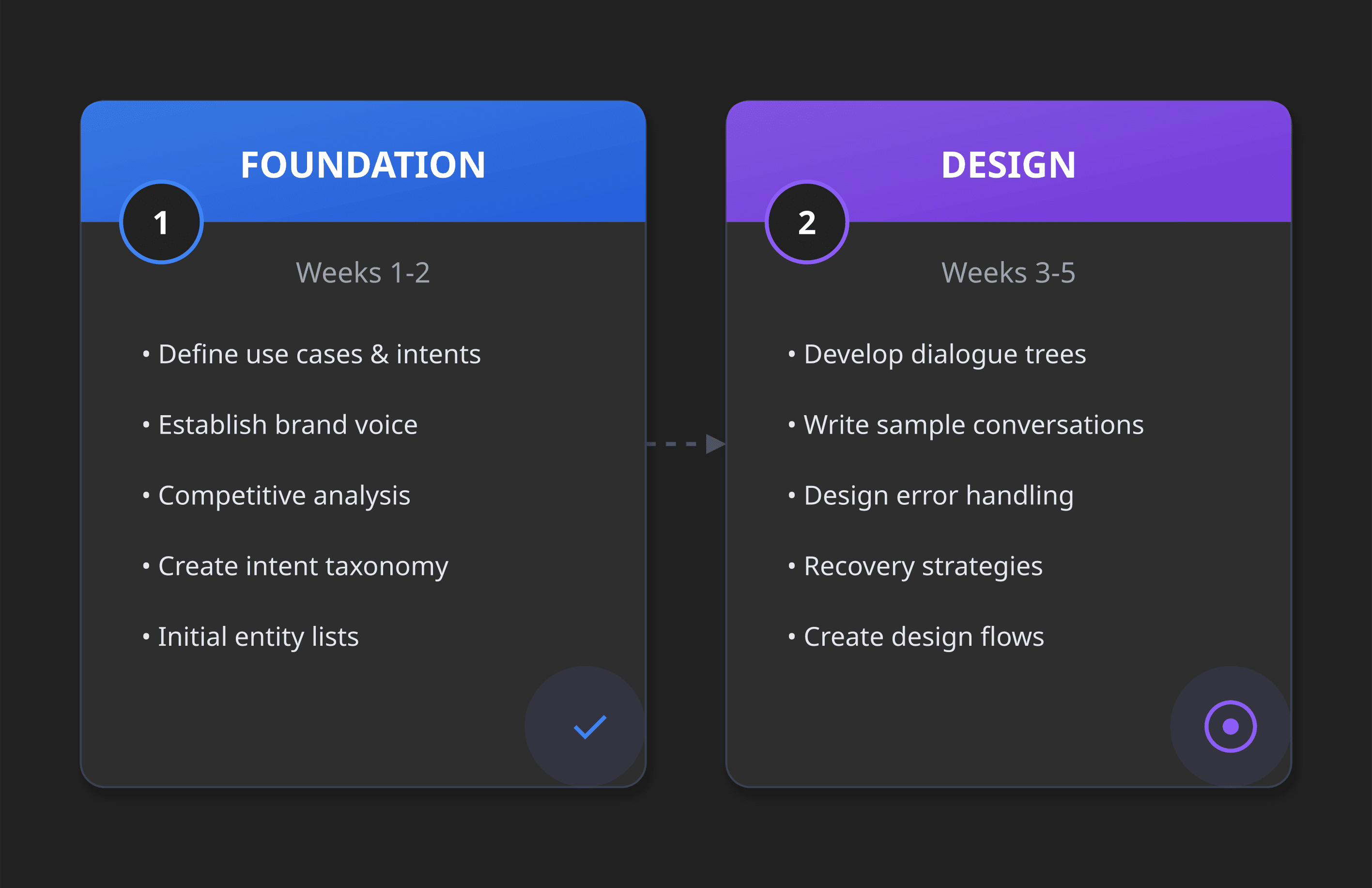
Phase 1: Foundation (Weeks 1-2)
Define primary use cases and user intents. Establish personality and voice guidelines aligned with brand. Conduct competitive analysis of similar conversational AI implementations. Create initial intent taxonomy and entity lists.
Phase 2: Design (Weeks 3-5)
Develop dialogue trees for core conversation paths. Write extensive sample conversations covering various scenarios. Design error handling and recovery strategies. Create conversation design documentation and style guides.
Phase 3: Prototype and Test (Weeks 6-8)
Build low-fidelity prototypes (Wizard of Oz testing). Conduct user testing with 8-12 target users. Analyze feedback and identify pain points. Iterate on dialogue design based on findings.
Phase 4: Build and Refine (Weeks 9-12)
Collaborate with development team on implementation. Test with broader user group. Refine based on real conversational data. Prepare conversation monitoring and analysis tools.
Phase 5: Launch and Optimize (Ongoing)
Soft launch with limited user group. Monitor conversations and key metrics closely. Identify common failure patterns. Continuously optimize dialogue and personality.
This timeline assumes a moderately complex conversational AI implementation. Simpler chatbots might condense phases; more sophisticated AI agents might extend them.
What's Next for Conversational AI Design
Several trends are reshaping the field in 2026:
Multimodal experiences blend voice, text, and visual elements. Users might start on voice, get a visual confirmation on screen, then continue via text. Designing coherent experiences across modalities is the new frontier.
Emotional intelligence in AI is advancing rapidly. Systems can detect frustration, confusion, or urgency in user language and adapt accordingly. This opens new design opportunities but also raises ethical questions about manipulation and user autonomy.
Hyper-personalization leverages user history, preferences, and context to tailor every conversation. The same AI might be formal with one user and casual with another based on learned preferences.
Ambient computing embeds conversational AI throughout environments homes, cars, workspaces. Design must consider context-switching, interruptions, and privacy in new ways.
These trends reinforce how critical thoughtful conversational AI design has become. As the technology evolves, the human-centered design approach becomes more, not less, essential.
Why Specialized Expertise Matters
Conversational AI design sits at the intersection of multiple disciplines UX design, linguistics, psychology, machine learning, and content strategy. Few individual designers master all these domains.
That's why partnering with experienced teams matters. At Brandhero, we've invested in building specialized capabilities in conversational design alongside our core UI/UX design services. This isn't just about learning new tools it's about developing new ways of thinking about user interaction.
For startups and companies exploring conversational AI, the temptation is to bolt a chatbot onto your product and call it done. Resist this. Poorly designed conversational experiences damage your brand more than having no conversational AI at all.
Instead, approach conversational AI as a strategic design initiative worthy of proper research, design, and testing. Invest in understanding your users' conversational patterns and preferences. Define clear success metrics beyond simple implementation.
The ROI of thoughtful conversational AI design compounds over time. Every successful interaction builds user trust and satisfaction. Every avoided frustration prevents churn. As we've explored in our analysis of the business value of UX design, design that solves real user problems translates directly to business outcomes.
Closing Thoughts
Conversational AI represents a fundamental shift in how humans and technology interact. Done well, it democratizes access to information and services, makes complex systems approachable, and creates genuinely helpful experiences.
Done poorly, it frustrates users, damages brands, and reinforces the worst stereotypes about unhelpful bots.
The difference lies in design not just the underlying technology, but the conversational flows, personality, error handling, and continuous optimization that make interactions feel natural and valuable.
The conversations your users have with your AI shape their perception of your entire brand. Make those conversations worth having.
If you're navigating conversational AI design challenges, we'd love to discuss. Check out our case studies to see how we approach complex design challenges, or reach out to explore how strategic conversational design could transform your user experience.
Explore all blogs

Jun 18, 2026
Enhancing Customer Service Through UX Design & Strategic Audits
Enhancing Customer Service Through UX Design & Strategic Audits

Jun 16, 2026
User Insights: Unlocking Design Decisions with Data
User Insights: Unlocking Design Decisions with Data

May 31, 2026
User Experience Optimization: Boost Conversion & Retention
User Experience Optimization: Boost Conversion & Retention

May 31, 2026
User Experience Optimization: Fixing Friction for Growth
User Experience Optimization: Fixing Friction for Growth

May 11, 2026
Phone Number Chunking: Reduce Errors & Improve Conversion Rates
Phone Number Chunking: Reduce Errors & Improve Conversion Rates

May 9, 2026
Mastering Gating in UI/UX Design: Convert Without Pushing
Mastering Gating in UI/UX Design: Convert Without Pushing

May 7, 2026
Gestalt Laws Explain Visual Grouping for Designers
Gestalt Laws Explain Visual Grouping for Designers

May 6, 2026
Checklist for Evaluating Microinteractions in UX
Checklist for Evaluating Microinteractions in UX